
For nursing home administrators
Resident turning: recorded, verified, defensible.
You carry the liability for every resident in your building. Without real oversight, that is a gamble. Guardian Agents turns it into informed supervision: your DON sees every deviation as it happens, protocols are followed, and the proof is recorded and kept for the day you need it.
A small sensor on each resident records every turn, the time held in each position and any self-turn, against the care plan. The record flows into your EHR. Your DON acts on the exceptions. You get peace of mind instead of a gamble.
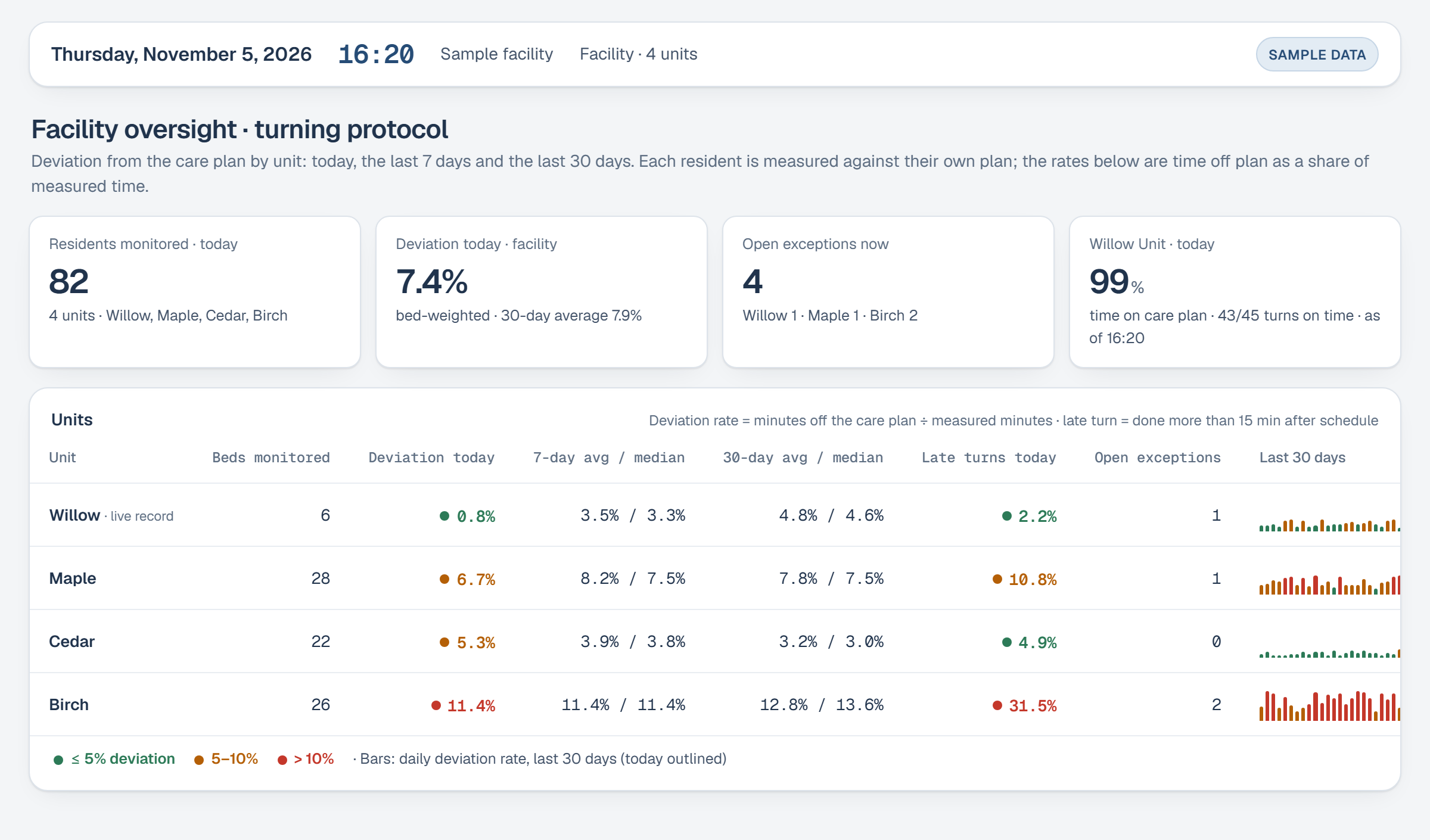
Average and median per unit, late-turn rates and open exceptions. The view an administrator opens, not a single room.
Sample data. Willow's figures come from the same record as the unit dashboard.
What this means for you
Peace of mind
Protocols are followed and quality of care is assured, on every unit, every shift. You know it. You don't hope it.
Full oversight for your DON
Your DON sees every deviation as it happens and closes it while it is still minor.
Proof on record
Every turn is recorded and kept, ready for surveyors, payers, insurers, families and counsel.
More beds, same staff
Less oversight load frees your nurses. Beds you could not staff become beds you can fill.
Resident welfare first.
Adherence to the turning protocol is what facilities rely on to prevent pressure injuries. It is the necessary protocol, and the hardest one to verify. Today the evidence is usually a note in the chart, written after the fact.
Guardian Agents replaces guesswork with a record: when the turn happened, from which position to which, how long it held and whether the resident self-turned. Your DON sees patterns across residents and shifts and corrects them early. Your team fixes deviations from protocol while they are still minor, and the resident is the first to benefit.
What is at stake.
- The resident
- A facility-acquired pressure injury means pain, a longer stay and often a hospital transfer, which can cost the facility rehospitalization penalties and clawbacks.
- The payment
- Readmissions cut your Medicare payment under SNF value-based purchasing, and Medicare Advantage and Medicaid managed care plans claw back what they can. Pressure injuries drive readmissions and show in your public quality measures. Turning is the lever you control.
- The survey
- A facility-acquired pressure injury can lead to an F686 citation, civil money penalties and a public mark on Care Compare. A timestamped turning record sits right beside the written protocol.
- The lawsuit
- Pressure injuries are a common subject of long-term-care litigation. A paper-chart checkbox or sporadic data entry is a thin defense. A timestamped and recorded turning audit trail gives your counsel facts to work with.
- The premium
- When care isn't provable, your insurer prices in the worst case. Audit-ready proof of care is what you bring to renewal.
- The reputation
- Families, referral partners and ownership read Care Compare and hear about incidents. Proven care defends your star rating and your referral pipeline.
Capacity: fill the beds you can't staff today.
Across the country, beds sit empty for one reason: there are not enough nurses to support them. Staffing shortages and 70% turnover put the oversight burden on the nurses you have, and every hour spent chasing turn sheets is an hour not spent on residents.
Guardian Agents takes the charting and the oversight load off your team. Your DON reviews exceptions instead of chasing paper, so the same staff can safely serve more beds. That is revenue on top of the leakage you stop.
It also builds trust when your floor changes every week. Agency staff and new hires work to the same protocol, and the record shows it.
For your risk, legal and compliance colleagues.
Facts, timestamped, when the question comes.
When a surveyor, a payer, a family's attorney or your insurer asks whether the turning protocol was followed, the usual evidence is a note in the chart. Guardian Agents gives your counsel a timestamped record of every turn beside the resident's own care plan: from which position to which, how long it held, whether the resident self-turned, and how each deviation was caught and corrected. Alerts, acknowledgements and staff notes complete the audit trail.
When care isn't provable, insurers and litigators assume the worst. With Guardian Agents, your counsel and your underwriter get the same thing: proof the protocol was followed.
- Surveys and complaints
- The written protocol beside the measured record, by resident and by unit: today, 7 days, 30 days.
- Claims and clawbacks
- Timestamps, positions, durations and the staff response, on the record when the question comes. Not a reconstruction from memory months later.
- Underwriting
- Audit-ready proof of the turning protocol, in front of your underwriter at renewal.
ROI potential: built for thin margins.
A small monthly line against a large, recurring exposure. Before you ask whether you can afford it, ask what one unprovable pressure injury costs you.
And that is before capacity. Every bed your staff can now safely serve is revenue on top.
Your whole facility, at a glance.
When ownership, a surveyor or a family asks how turning is going on a unit, you answer from the facility view: the percentage of deviation today, over the last 7 days and the last 30 days, average and median, by unit, with late turns and open exceptions. You see where care quality holds and where it slips, before it becomes a citation or a claim.
What would it take in my building?
No infrastructure to install and no project plan. Guardian Agents runs on your existing Wi-Fi. A nurse places the sensor on the resident and pairs it with a phone scan. No gateways, no servers, no interface project, no extra charting.
Your EHR stays the chart. The turning record flows straight into it through an official marketplace integration. Your DON gets fewer turn sheets to chase, not another screen to feed. Turning is the first protocol; upright positioning, mobilization, gentle handling and falls follow on the same sensor.
It starts with a conversation about your residents, your protocol and your goals. Yogev works through it with you and your nursing leadership, and you decide what comes next.
Share the right page with the right person.
The administrator brief puts peace of mind, the economics and the stakes on one page. The nursing brief shows your DON and CNAs the phone view and how deviations get caught and closed.
Oversight of the turning protocol, on your DON's phone.
Learn more: Nursing and care-team briefQuestions we hear
We can't afford another system. Our budget is razor-thin as it is.
That is exactly why it is priced against the leakage, not against the software budget. Guardian Agents is designed to pay for itself many times over: one serious pressure-injury claim, around $240,000, equals the system's cost for a 100-bed facility for about ten years. The leakage you already carry per bed is more than twelve times the yearly cost, and the beds your staff can now serve are on top of that.
How do I make the case to ownership?
In their language: a small monthly line against a large, recurring exposure, more beds the same staff can serve, and audit-ready proof of care they can show an insurer, a surveyor and a family. The administrator brief puts it all on one page you can forward.
How does it fit our EHR and our IT?
Your EHR stays the chart. Guardian Agents sends the data from each paired sensor through our platform straight into your EHR, through an official marketplace integration. Your IT team enables a VPN connection and internet access. That's it.
Will my DON and CNAs see this as more work?
No. It takes work off them. The record creates itself from the turn, so there is no turn sheet to fill and no shift to reconstruct. Your DON reviews exceptions on a phone instead of chasing paper, and alerts go out only when a resident is off plan or a turn is overdue.
Will staff feel watched?
The sensor is on the resident, not on staff. It records position and motion only, never speech or video. It records the care your team delivers, so on-time turns are on the record as on-time turns.
What does the record do for us in a claim?
It is your defense. When care isn't provable, insurers and litigators assume the worst. A timestamped record of every turn and every response, with deviations caught and corrected while still minor, gives your counsel facts instead of a reconstruction.
What will surveyors make of it?
Surveyors look for a resident-specific plan that was carried out and monitored. The record puts the written plan beside what happened, by resident and by unit, for today, 7 days and 30 days, so your team answers from facts, not from memory.
What do we tell families?
That a small sensor records when their loved one is turned and how long each position holds, with no camera and no microphone. And when a family asks whether a turn happened, you can show them, not just tell them.
What will the record show?
Proof of protocol adherence: every turn with its timestamp, from which position to which, how long each position held, any self-turn, and every deviation with how and when it was corrected. All in care quality context, against the resident's own care plan.
We rely on agency staff. Will that work?
Yes. Pairing is a phone scan of the wristband and the sensor, and the record does not depend on who is on shift. The record of the care stays even when the people on the floor change.
How do we start?
With a conversation with Yogev, our founder. Come as you are. He shows you the record and the facility view, and you decide what comes next.
A conversation with the founder
Put proof of care behind your facility.
We invite you to a conversation with Yogev Wallach, our founder. Come as you are.
Schedule a meeting with Yogev. Pick any open time.
or email yogev@guardian-agents-us.com